

Fossil-free graphite
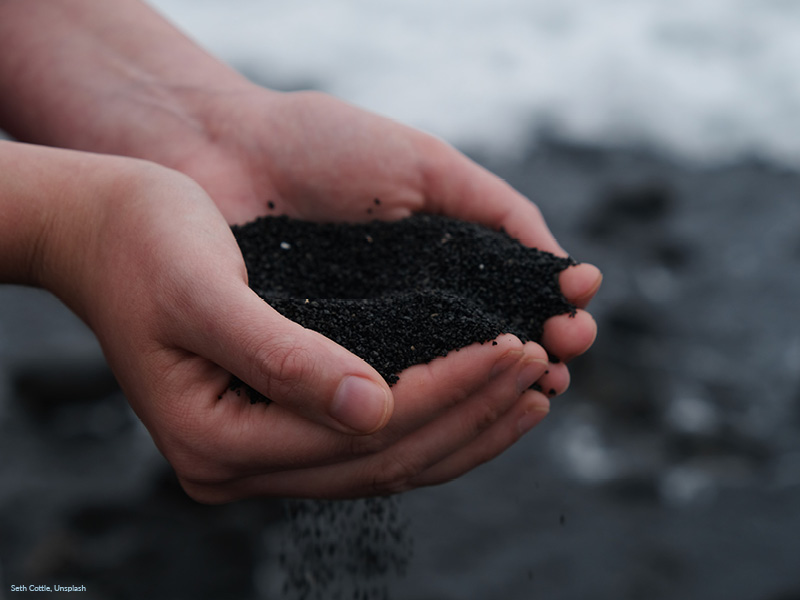
Graphite is widely used in process industries, E-mobility and digitalisation. Its consumption has increased rapidly due to increased production of lithium-ion batteries globally. The graphite demand in Swedish metallurgical industries will increase due to fossil-free steel production, in which the EAF (Electrical Arc-Furnace) process is increased.
Today, all used graphite comes from natural graphite mines or fossil-based artificial production. The main purpose of this project is to develop a production process, low in energy consumption and CO2 emissions, to produce fossil-free graphite that can be used for electrodes in EAF and anodes in battery applications.
The proposed process is based on catalytic graphitization of biomass-derived biochar. Suitable catalysts will be screened, and optimization of process parameters will be conducted. Finally, a process with details parameters will be proposed.
Read about preliminary results from December 2022 here.
Here you can find the complete list of publications from the project.
Weihong Yang
KTH Royal Institute of Technology

weihong@kth.se
Project information
Participants
KTH
Uppsala University
EnviGas Technology AB
Schedule
January 2022 - December 2024
Total project cost
5 943 607 SEK
The Swedish Energy Agency's project number
2021-00048
More projects
Biogas Scenarios
Biogas is associated with several benefits, that can support a societal transition towards a circular economy with reduced climate impacts. The national…
Manager: Thomas Hans-Martin Magnusson
Ongoing
An insects biorefinery approach as a strategy to unlock the nutritional and energy potential in co-located lignocellulosic industrial side streams (UNLOCK)
The UNLOCK project aims to meet the EU’s Renewable Energby Directive (RED) II by transforming Brewer’s Spent Grain (BSG) into advanced biofuels…
Manager: Paul Christakopoulos
Ongoing
Reserve power service based on biogas
This project is about a service for back-up power supply with biogas. It will develop overall technical and business concepts for such…
Manager: Steve Karlsson
Ongoing